New York At Its Best
The Yankee Stadium
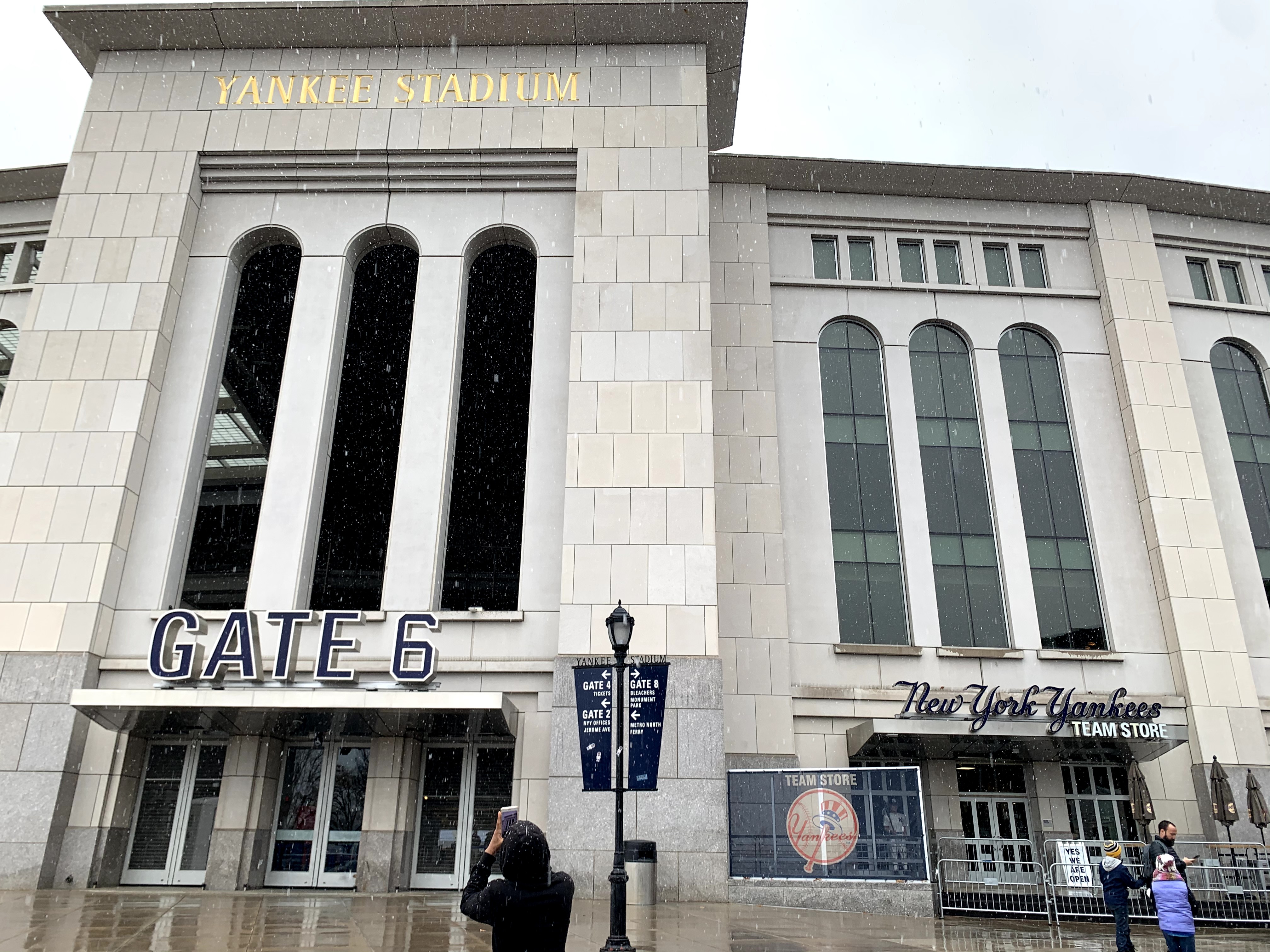
On Monday of my week of discovering the secrets New York had to offer, I went to the new Yankee Stadium on 161st Concourse, Bronx NYC. There is two stadiums, we visited the new one built in 2009.
Highlights:
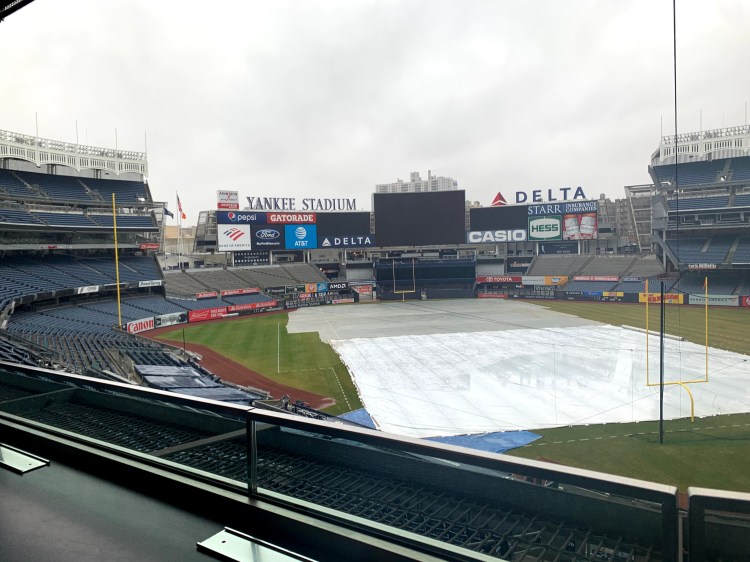
This is the Media Box, here many news ancors sit and report the game for their articles. This was one of my top three favorite places in the Yankee Stadium because from here you had a perfect view of the whole field.
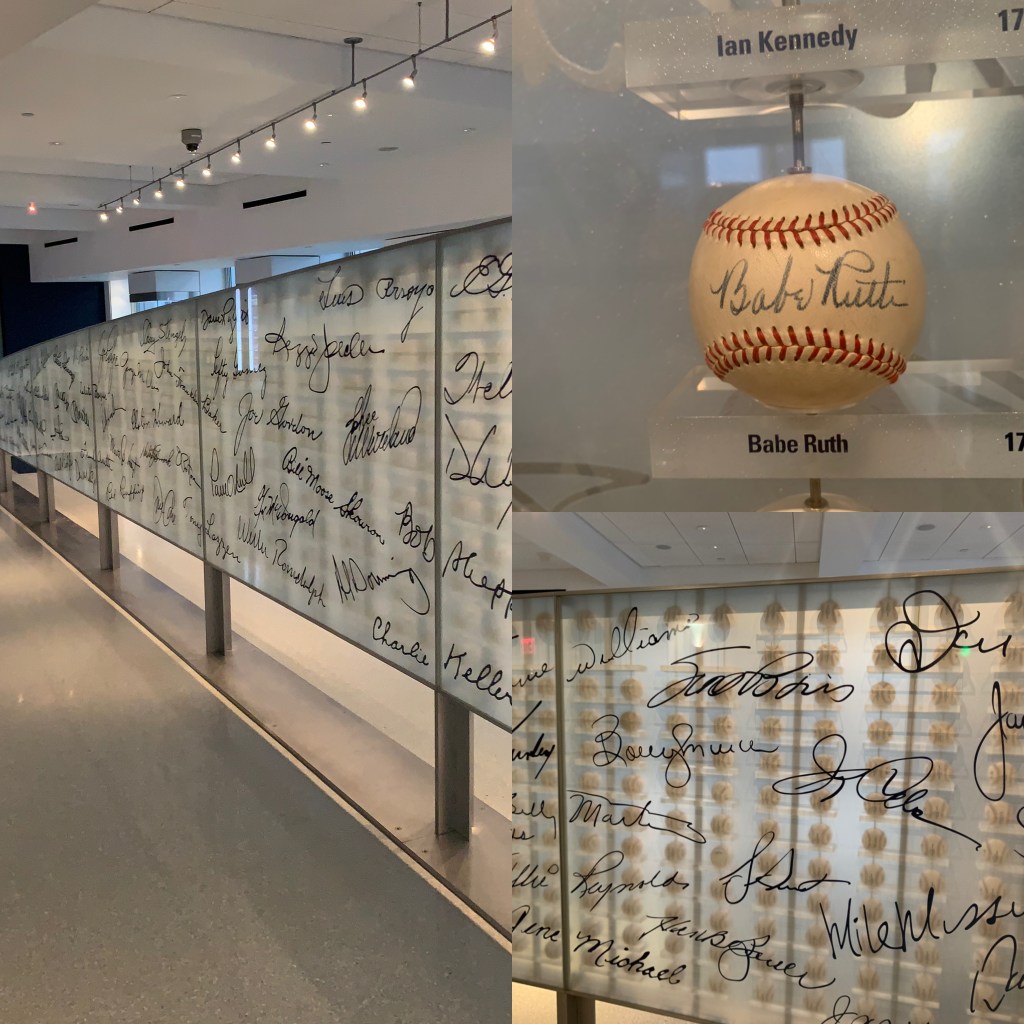
This here is “The Perfect Game” it is double sided, on the front is a transparent glass with many big black signatures of passed players. This is located in the museum part of the Stadium. I enjoyed this part because it was fun searching for the signed baseballs, and informative to actually see how many played in the MLB, since i am used to basketball.
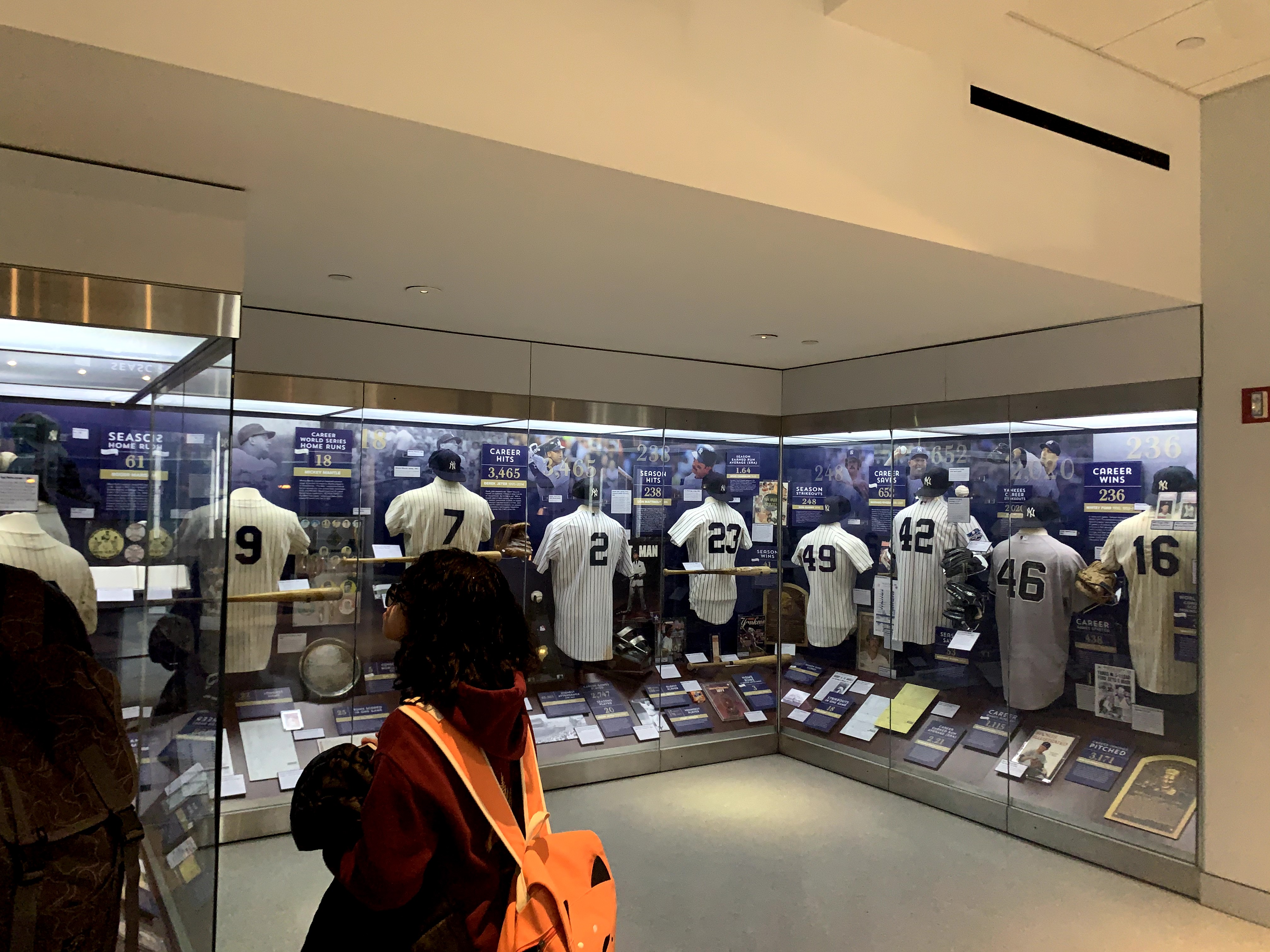
This is the Museum, in this particular spot the tour guide showed us all the jerseys that had been retired. A number of 21 retired jerseys. I liked this spot because I liked looking at the reasons why they have been retired and how the jerseys have changed in general throughout time.
History:
The stadium was built from 1922 to 1923 for $2.4 million ($33.9 million in 2016 dollars). Its construction was paid for entirely by Yankees owner Jacob Ruppert, who was eager to have his own stadium after sharing the Polo Grounds with the New York Giants baseball team the previous 10 years. Yankee Stadium is a baseball park located in Concourse, Bronx, New York City. It is the current home for the Yankees. The final cost for the stadium was more than $3.1 billion 50,287 fans can be seated, with a standing room capacity of 52,325. The new stadium was built because the team wanted a new ballpark built in order to generate additional seats and to offer fans more seating area and luxuries. The newer stadium was funded by $450 million paid equally by both the Yankees organization and New York City taxpayers
Around this time in New York, a beautiful look at the glamour and glitz that defined New York in the 1920’s. The end of World War I welcomed a new era in New York, one in which jazz, illegal booze, gangs, commerce, and culture flourished. Everyone was employed due to the fact that the united states strives when at war, many factories opened up women were working in factories and men were out at war. Everyone was getting money so the 1920’s was considered The Roaring Twenty’s since everyone was employed and the barrier between lower, middle, and high class was more or less balanced out. Back then this stadium brought many tourist to New York City, which one of the many things that helped the city gain its popularity.
The Yankee Stadium is known for being home to the New York Yankees, and was home to the best baseball players in the world. But in 1923 when it opened, it was the largest and most magnificent stadium in baseball and was home to many legendary players. It was kind of obvious but I learned that Lou Gehrig’s Disease was named after Lou Gehrig a baseball player who died at the age of 37. He played along side of Babe Ruth and was considered to be one of the best players in Yankee history. Another Yankee “secret” I learned was that Babe Ruth died two months later at age 53, reportedly of throat cancer, brought on in part by a fondness for tobacco and liquor. Dr. William Maloney says Ruth died of a rare form of cancer, nasopharyngeal carcinoma. The nasopharynx is a small area inside the head, above the soft palate and leading to the sinus.
This landmark gives historical significance to New York City because wildly popular players like Babe Ruth, Lou Gehrig, Derek Jeter, Mickey Mantle, Mariano Rivera, Yogi Berra, Alex Rodriguez have, and currently play in the New York Yankees in the old/ new stadium. In 2019 The Yankee Stadium ranks in about 40,668 people yearly, being a reason why many people, baseball fans in particular come to the stadium to tour from all over the country.
Personal Experience:
In general I have never been a huge Baseball fan I am more of a Basketball fan. But during The Yankee Stadium tour I grew respect for it. I observed how the tour guide talked about players such as Babe Ruth and Mickey Mantle, he was fascinated. He spoke with gratitude and absolute enjoyment. I was confused I always thought about Baseball as “ehh” I never gave it mind. But today I did, its a very liked sport with a rich history and am glad I opened my eyes to more than I was comfortable, and I enjoyed it. If i was to rate I would give it a 3.5.
The Transit Museum
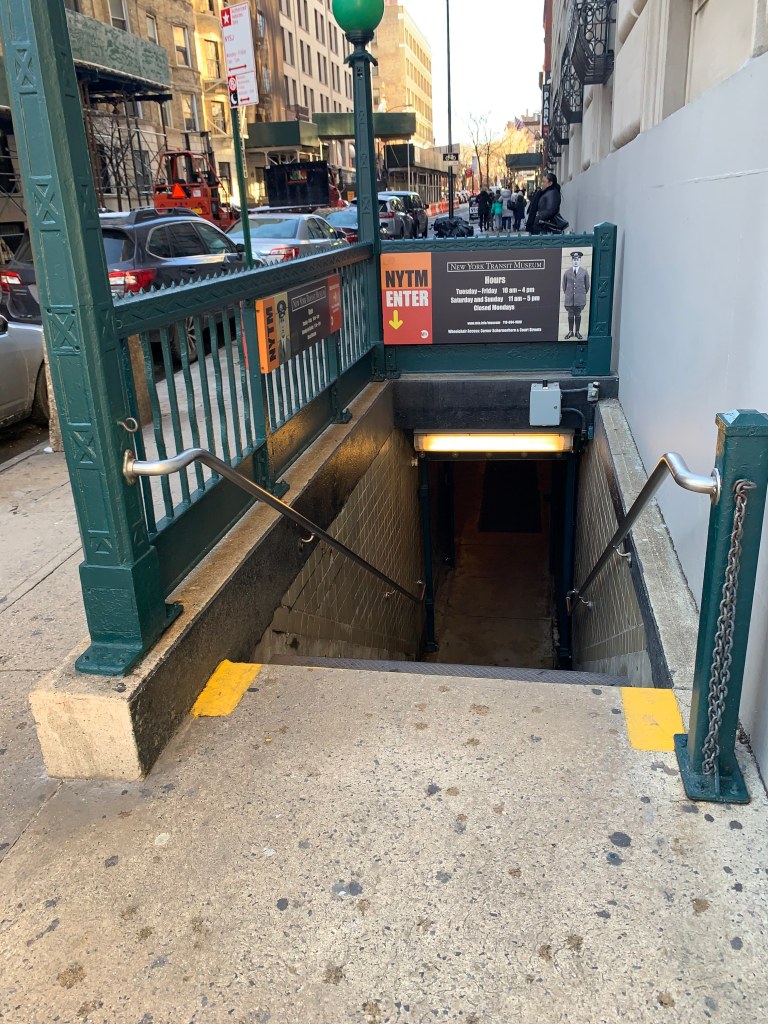
On Tuesday of my “exploring New York City” adventure we went to The Transit Museum in 99 Schermerhorn St, Downtown Brooklyn, NYC.
Highlights:
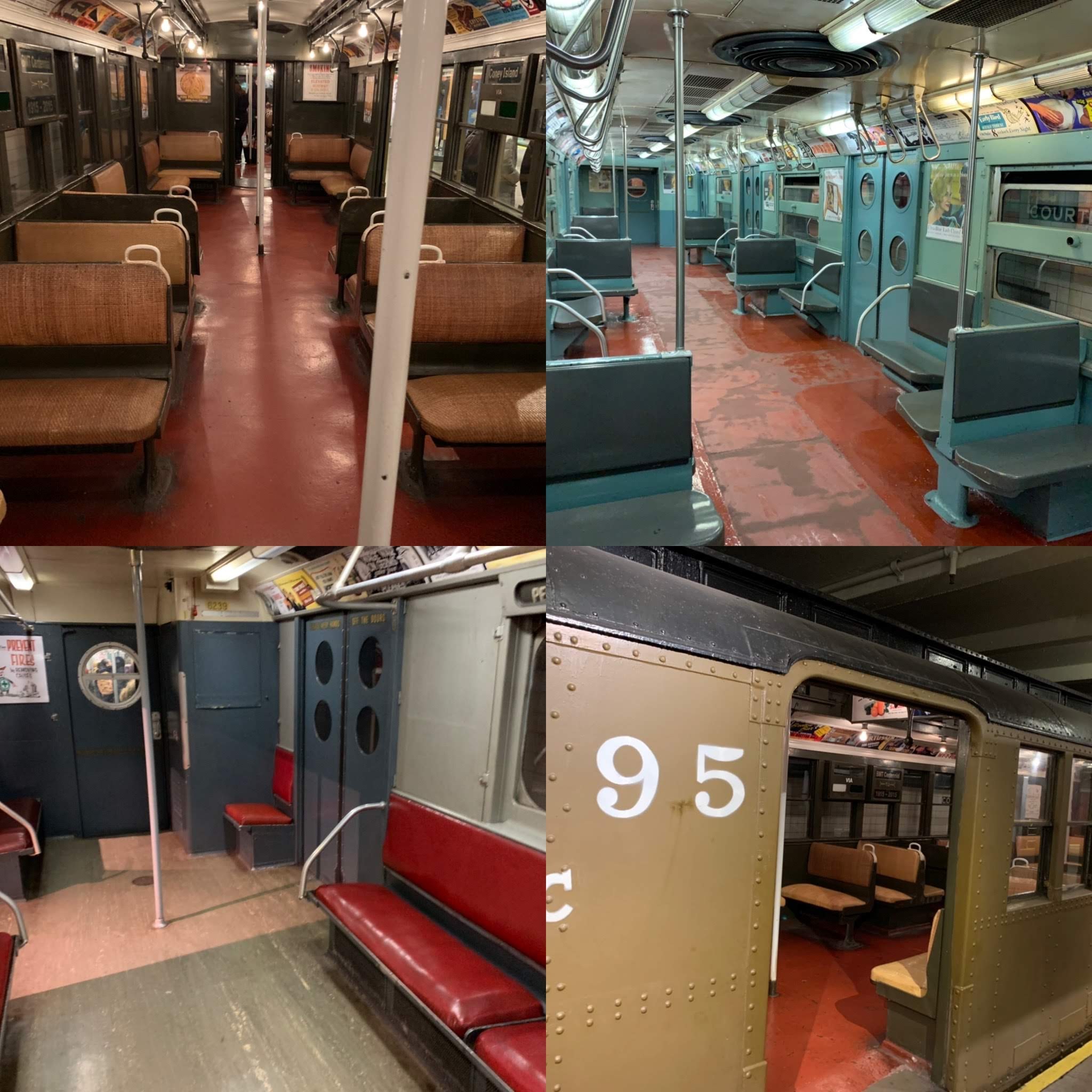
This was my favorite of all three places. This was the train exhibit, it showed us trains from early 1900 to current day trains. We saw the difference in chairs placement, and types of chairs. I really enjoyed watching how the train changed over time and which was considered modern and in what year. The trains went from having a wooden exterior to an iron one. The chairs in trains used to be fulled of horse hair which wasn’t very hygienic, when food would be spilled over seats, what ever was spilled would rot and create a bad smelling odor. Also the type of material that was used to create the chairs would often break, poking people on their backs/ thighs. In the Blue Bird trains, they had red leather seats. This was definitely an upgrade from the early 1900 trains but since many people a day would ride the Subway, the leather would deteriorate. Finally modern day chairs, this is the best solution because it is plastic so if someone where to drop food or beverage, it would just slide off or can be easily cleaned. I loved this place because I love history in general so this was the best place for me.
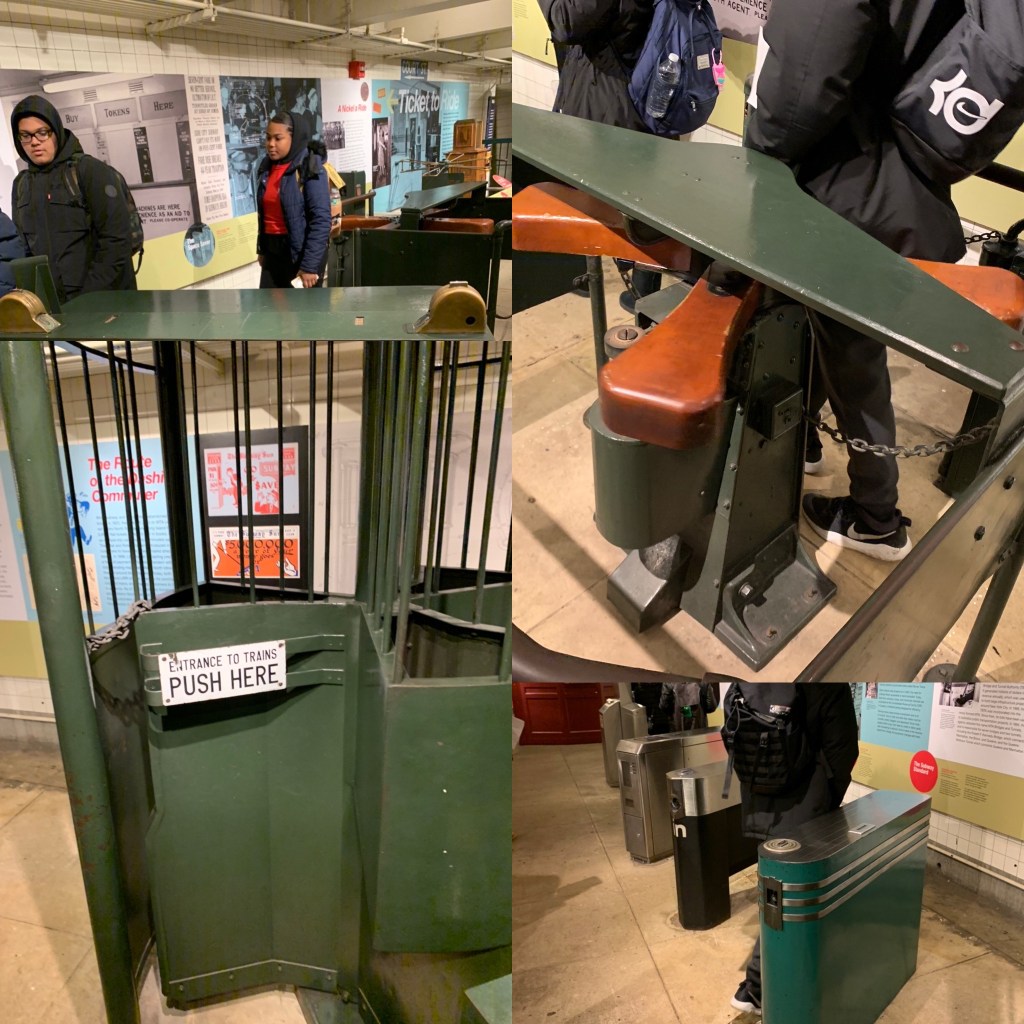
This part I also enjoyed because I like seeing how many things changed over time. In this specific part we looked at was the subway turn tables and how they upgraded throughout time. The first photo is relatively the oldest, its just a large table with large wooden turntables attached under the table. Then zoom to the bottom right photo is a more recent turntable that we see whenever we take the train.
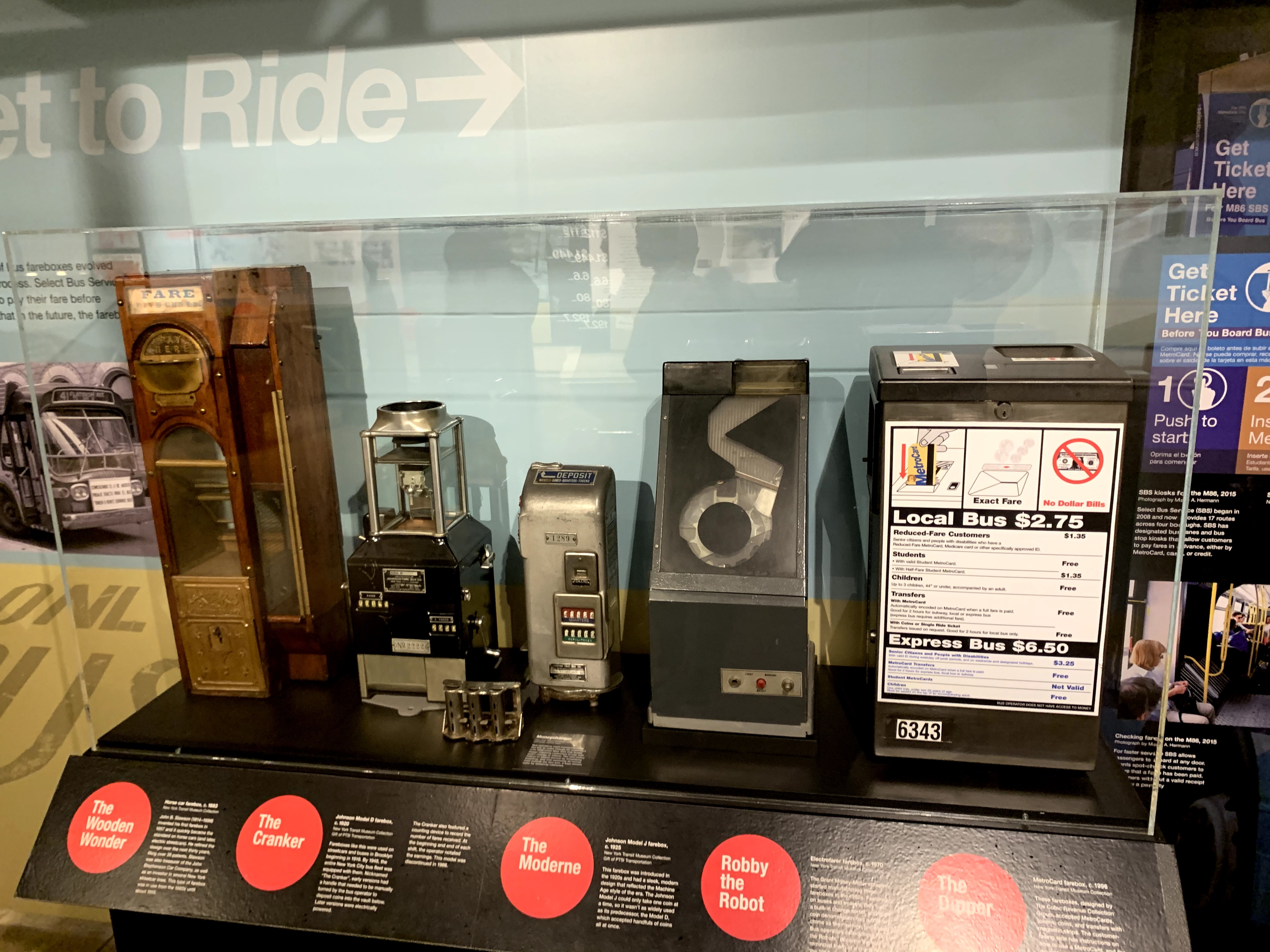
This highlight was specifically for trains, but for buses. Here we see five different forms of ways the money would me collected from buss passengers. the first one is “The Wooden Wonder”, it is a big wooden transparent box with two slots, one for the money at top and another for a key to retrieve the money in the end. Through time everything changes, but at the end of this we see the most recent money interceptor called “The Dipper” since you had to “dip” your metro card into the slot. On this particular machine there is two slots, one for the metro card and another for your tokens. This was because on the way to fazing out metro cards, people still sometimes used tokens so for a while, some trains/ buses still accepted both.
History:
This museum is created within a subway station. The museum was founded in 1976 by the city. It was built so that it can devote its space to pay tribute to our past and telling and preserving stories of mass transportation. Since the setting of this museum is a running and working subway, they just placed the artifacts within it, such as the old and restored trains, models on NYC in the early 1900’s.
New York City in the early 1900’s/ late 1800’s was crazy, in need of innovations, a change. New York’s best transportation system was horses. But there was a crack in that system, horses are animals, they need sleep, food, and to pee and poop. They weren’t very reliable they could get sick and die, this is not what New York City could run on for very much longer. In the late 1800’s elevated trains were introduced but these didn’t stick for much longer due to this thing called noise pollution. Noise pollution is an excessive amount of loud noise that can be harmful to animals/ humans. So the majority of elevated trains were removed. If you want to see some elevated trains, there are some in Dyckman and the Bronx. They already tried elevated trains, New Yorkers tried the opposite, they tried underground trains. At first people were afraid of going underground but in the end this method was the most effective.
This subway station in Downtown Brooklyn, NYC puts mass transportation history on display. It shows us how we evolved, from wooden carts, to leather seats and to now. It puts our city’s history on blast. This museum is known for having the oldest subway trains on display. If you look at the more older trains much like me you’ll get intrigued, I have lived in New York my whole life but never have I known the history hidden within simple things such as trains.
The benefits that this museum adds to New York is giving and preserving more historical artifacts and stories and showing other New Yorkers where their everyday transportation to work or school started. we have to understand he past to get a better future.
Personal Experience:
Never in a million years would I have expected there to be a museum about trains, when I first saw it I was confused, “What is a transit museum?” “Did it show us about ways people are able to get around New York City?” Before this trip I was on par with the many other New Yorkers who used everyday items yet didn’t know the past behind it or never even payed mind to it. But e
ntering that museum changed my understanding of things, not only did I have fun but I learned a lot. This Museum is something that I will revisit I had a great time and I rate this Trip a 5. For any future incomers visit the train exhibit. I recommend this heavily.
Staten Island
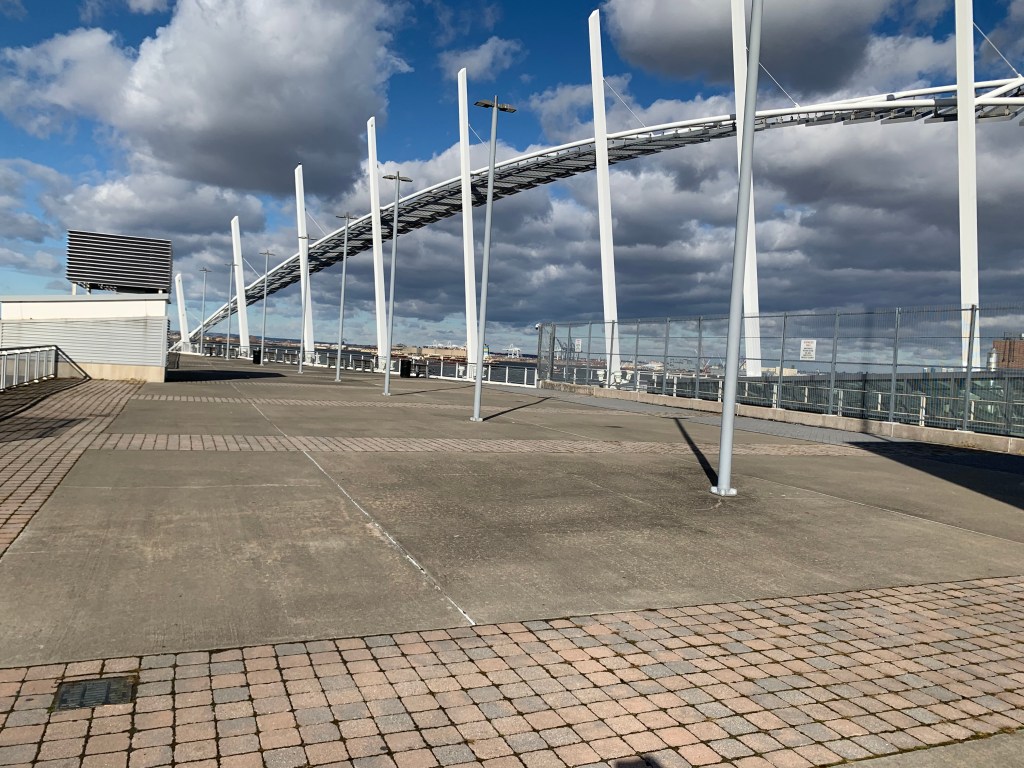
Finally, on my last day of exploring New York City and all its gems we went to many different places. We took the 1 train until the last stop and got off on the last stop (South Ferry). We saw many different places including Battery Park, Downtown Manhattan, Staten Island, JFK Ferry, The Freedom Tower, The Brooklyn Bridge, Ellis Islad and The Statue Of Liberty, the city skyline, The Atlantic Ocean a few more.
Highlights:
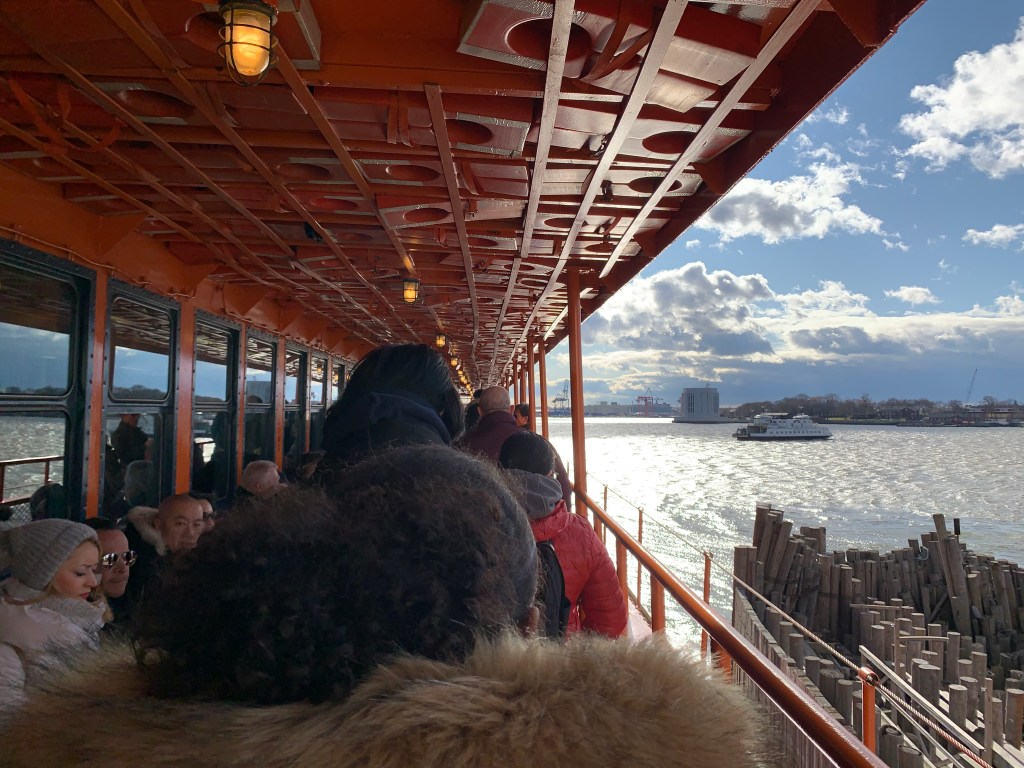
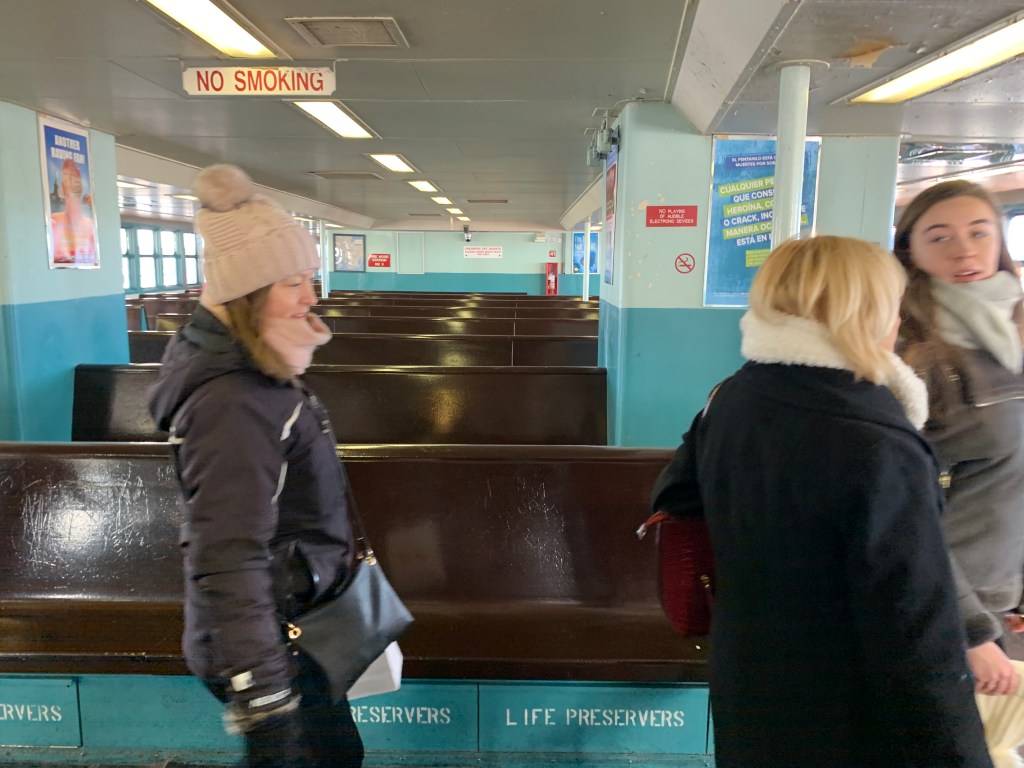
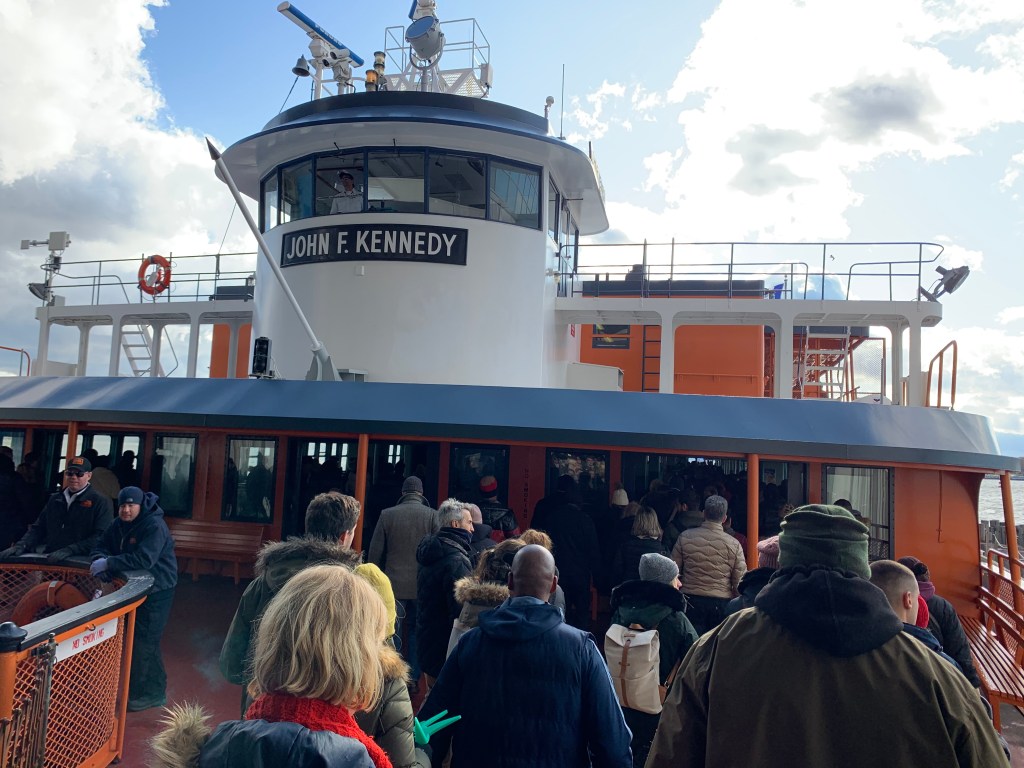
The Ferry was a highlight of mines because not only was it free but it was soothing. Being near the water just watching the boat move against the water is relaxing, I was leaning on the railing just observing the water react to the boat disturbing its serenity. But NYC Harbor isn’t safe at all. NYC Harbor is waters mixed of Harlem River, Hudson River and The Atlantic Ocean so despite it forest green color, waters are actually very clean. The Harbor actually is shark infested, making the water under the ferry far from safe.
A
 Site Title